

The Best Projectors for Bright Rooms
Direct sun can wash out even a powerful projector. The best projector for bright rooms still needs a sensible screen and some light control; the XGIMI HORIZON 20 Max is worth comparing.
We may earn a commission from links in this guide. As an Amazon Associate I earn from qualifying purchases.
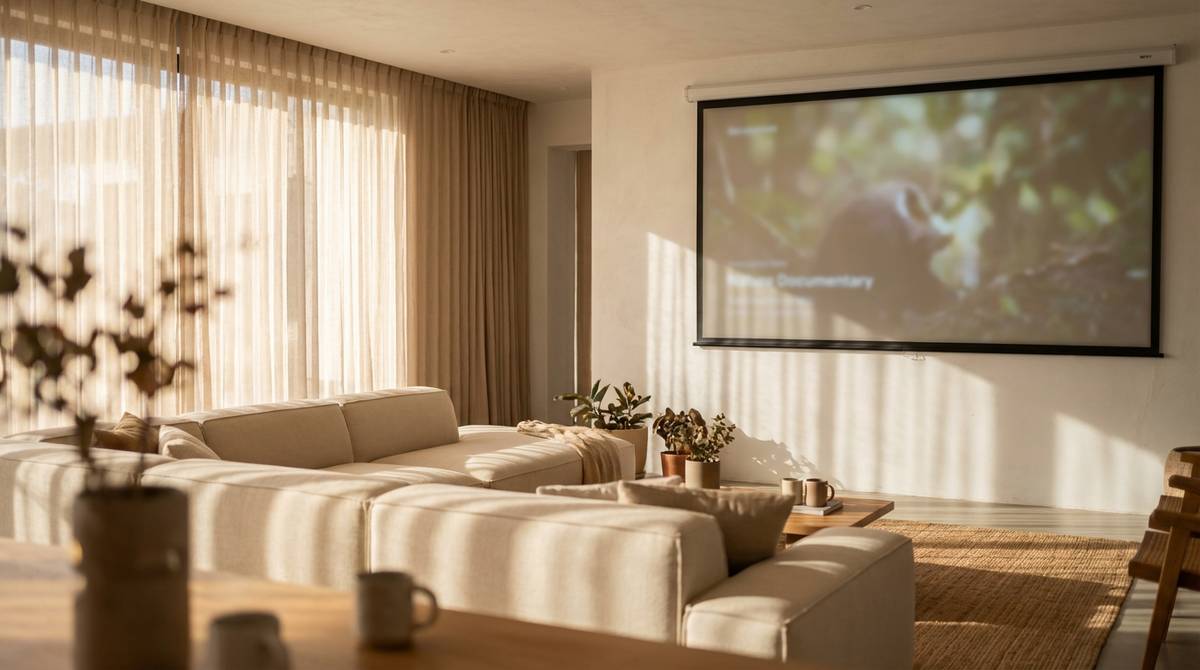
If sunlight falls directly on the screen, even an expensive projector can look pale. A bright-room purchase begins with the time of day you watch, the window light you can control and the surface receiving the image. The XGIMI HORIZON 20 Max is one option to compare, but a high brightness number by itself is not a plan for afternoon viewing.
The XGIMI HORIZON 20 Max is the flexible long-throw model we would consider first. Optoma’s GT2400HDR puts the lens closer; Epson’s Lifestudio Grand Plus belongs on a front cabinet. Those placements create different costs and furniture needs. Compare the picture at the hour you will watch, and be willing to choose a television if the room stays very bright.
Everything we recommend
Our picks

Our pick for a flexible living room
XGIMI HORIZON 20 Max
The HORIZON 20 Max is for the living room that can be dimmed but cannot become a dedicated blacked-out theater. Optical placement controls can help the lens line up with a screen without relying entirely on digital correction. That flexibility is valuable if the projector shares a room with normal furniture. Check the throw range and power location before deciding where to put it. In strong afternoon sun, curtains and a suitable screen are more meaningful than a brightness number read in isolation.

For short throw
Optoma GT2400HDR
The GT2400HDR can solve a room where the back wall is too close or an overhead mount is unwelcome. A short throw also means the projector may sit near people or the furniture used for viewing, so consider cable paths, fan noise and accidental bumps. Its 1080p picture may be a reasonable compromise for casual large-screen viewing, but do not choose it expecting the fine detail of the 4K alternatives. Measure the lens-to-screen distance for the image width you want.

For a straightforward setup
Epson Home Cinema 1100
The Home Cinema 1100 asks for a simpler, more deliberate setup. An existing streaming stick and a pair of speakers can complete it, while the lower-resolution lamp unit may be enough for occasional movies in a dim room. Put replacement lamp cost and the screen into the ownership budget. If the projector will be used every afternoon in a bright multipurpose space, choose based on the actual light you can control rather than assuming a projector will behave like a television.
The research

What bright room really means
A projector viewed with curtains open at noon faces a different challenge from one used under a lamp at night. Direct sunlight on the screen can flatten the image no matter how impressive the brightness figure sounds. Before paying for a brighter model, note when you watch and where light lands. A shade, screen position or better viewing time may change the result more than a modest jump in the advertised number.
The XGIMI HORIZON 20 Max and Optoma GT2400HDR can suit different positions and uses. The Epson Home Cinema 1100 is another route if you can accept its picture and placement tradeoffs. Judge the whole room, including the screen, not a number from two listings measured under different conditions.
Do not forget the evening picture
Brightness helps a room with ambient light, but it is not the only quality you will notice after dark. Blacks, color and fan noise can become more apparent during a film in a dim room. If the same projector serves daytime sports and nighttime movies, decide which compromise you are willing to live with. A retractable shade or separate screen may be a better investment than buying solely for the brightest daytime claim.
Set a screen size you can actually fill from the available position, then examine the image modes and input needs for your sources. A projector for a bright living room should be easy enough to use on ordinary days. If it requires rearranging the furniture each time, the large picture may be less inviting than it seemed in the store.
How to choose the best projector for bright rooms
A projector does not create black light. When sunlight or a lamp strikes the screen, dark parts of a movie rise toward gray even if the projector is powerful. The most useful first step is to block direct light on the image. A larger screen also spreads the same light across more area. A projector that looks vivid at 90 inches may feel flat at 130 inches in the same room.
For daytime sports or casual TV, think about when you actually watch. A room with blinds and side windows is different from an open-plan room with sun falling directly on the screen. If you cannot control the latter, compare a large television before making a projector your only display. A suitable screen can improve perceived contrast, but it cannot make direct sunlight disappear.
Where each pick fits
XGIMI HORIZON 20 Max: a flexible premium setup
XGIMI rates the Max at 5,700 ISO lumens and includes optical zoom and lens shift. Those placement controls are valuable if the projector will live on a shelf or mount in a room where you cannot put it perfectly centered. Its brightness gives you more headroom for a larger image, but do not read the number as a promise of deep blacks with the shades open.
Optoma GT2400HDR: short distance, 1080p picture
Optoma describes this as a short-throw Full HD laser model with a 4,200-lumen rating. It belongs on the shortlist when the room does not have enough depth for a standard throw. The tradeoff is resolution: it accepts modern sources, but it is a 1080p projector rather than a 4K display. At a very large size or close seating distance, that distinction may matter more than it does for sports across the room.
Epson Home Cinema 1100: a simpler 1080p option
Epson rates this 3LCD projector at 3,400 lumens for both white and color brightness under the stated standards. It is a practical comparison for a smaller screen and a budget that does not stretch to the premium laser choices. It is still 1080p, and its setup and light-source needs differ from the higher-priced models. Check the current manual for lamp life and replacement costs before deciding that the lower purchase price is the whole cost.
ViewSonic LS901-4K: installation-oriented brightness
ViewSonic lists 5,500 ANSI lumens and 4K UHD for this laser installation model. That makes it relevant for a large image in a multipurpose space, but it is closer to a planned installation than a small smart projector you move between rooms. Verify throw, mounting, audio and streaming sources as part of the budget.
Epson Lifestudio Grand Plus: front-of-room furniture
This ultra-short-throw route places the projector near the screen rather than on the back wall or ceiling. It can make cable routing easier in a living room. The screen and cabinet become part of the decision: the projector’s position needs to be precise, and a wavy or textured surface will be obvious. Compare the complete setup cost, not only the projector box.

For a larger installation
ViewSonic LS901-4K
The LS901-4K is worth comparing for a more permanent 4K installation where you can place a conventional projector at the right distance. Its published brightness is only one part of the decision: picture mode, screen material and ambient light affect what reaches your eyes. Verify throw and mounting requirements before paying for a model aimed at larger spaces.
Brightness numbers need context
Manufacturers may quote ISO, ANSI, white or color brightness, sometimes in different picture modes. These are useful specifications, but numbers using different standards should not be treated as a simple ranking. A maximum-brightness mode may also have a different color balance than the mode you prefer for movies. The figures listed here are manufacturer ratings; compare them under the same measurement standard.
Measure the image you want, the throw distance from lens to screen and the available mounting position. Compare the manufacturer’s calculator for that exact model. If daylight is the priority, try a modest screen size and keep the screen out of the path of direct sun. If night movies are the priority, contrast and dark-room picture quality deserve as much attention as lumens.
For an ultra-short-throw setup, ask whether the chosen screen is designed for that projection angle. A conventional ambient-light-rejecting screen for a back-of-room projector is not automatically suitable for an ultra-short-throw unit. Even a small screen wave can distort the picture near the top edge.

For a console position
Epson Lifestudio Grand Plus
The Grand Plus keeps the projector on a cabinet below the screen, avoiding a ceiling mount or long video run. Its ultra-short-throw geometry needs a flat screen and precise cabinet dimensions, so it is not automatically the easiest bright-room purchase. Price an appropriate screen with the projector and check the light coming from windows near the image.
Bright room does not mean direct sun
A projector adds light to a surface; daylight falling on that surface raises the apparent black level. Even a high advertised lumen figure will not make a dark movie scene look like a television in direct sun. Start with blinds, the time of day you watch and a screen suited to the projector’s throw. A 100-inch image will be easier to light than a larger one from the same unit. Compare brightness figures carefully because maker measurements and usable picture modes can differ.
For sports with some lamps on, prioritize a placement that fits the room and a screen that does not wash out. An inexpensive 1080p projector in a controlled room can be more satisfying than an expensive 4K model aimed at a bright wall. For a living room that must work at noon with open windows, price a large TV as an alternative. If you choose a UST, check a screen made for that geometry; an ordinary long-throw ALR screen is not a safe default.
Questions before you buy
Will a brighter projector look good in direct sunlight?
It may remain visible, but dark scenes lose contrast. Shade the screen first. If direct sunlight cannot be avoided, a television is usually the simpler daytime choice.
Should I choose 1080p or 4K for sports?
Resolution depends on source quality, seating distance and image size. A bright 1080p picture can be satisfying for casual sports. For a very large screen and high-quality 4K movies, a 4K model may justify the higher cost.
Does an ultra-short-throw projector need a special screen?
It needs a flat, suitable surface. If you want ambient-light rejection, use a screen specified for ultra-short-throw projection. Confirm its dimensions and cabinet placement with the projector manual.
How were these picks compared?
We compared manufacturer brightness ratings, resolution, throw category and placement needs, then matched them to realistic room types. Source specifications include XGIMI HORIZON 20 Max, Optoma GT2400HDR, Epson Home Cinema 1100 and ViewSonic LS901-4K.